What Students Built
Production-quality healthcare tools — designed and built by medical students with no coding experience, in 10 days.
Projects
FCM Companion
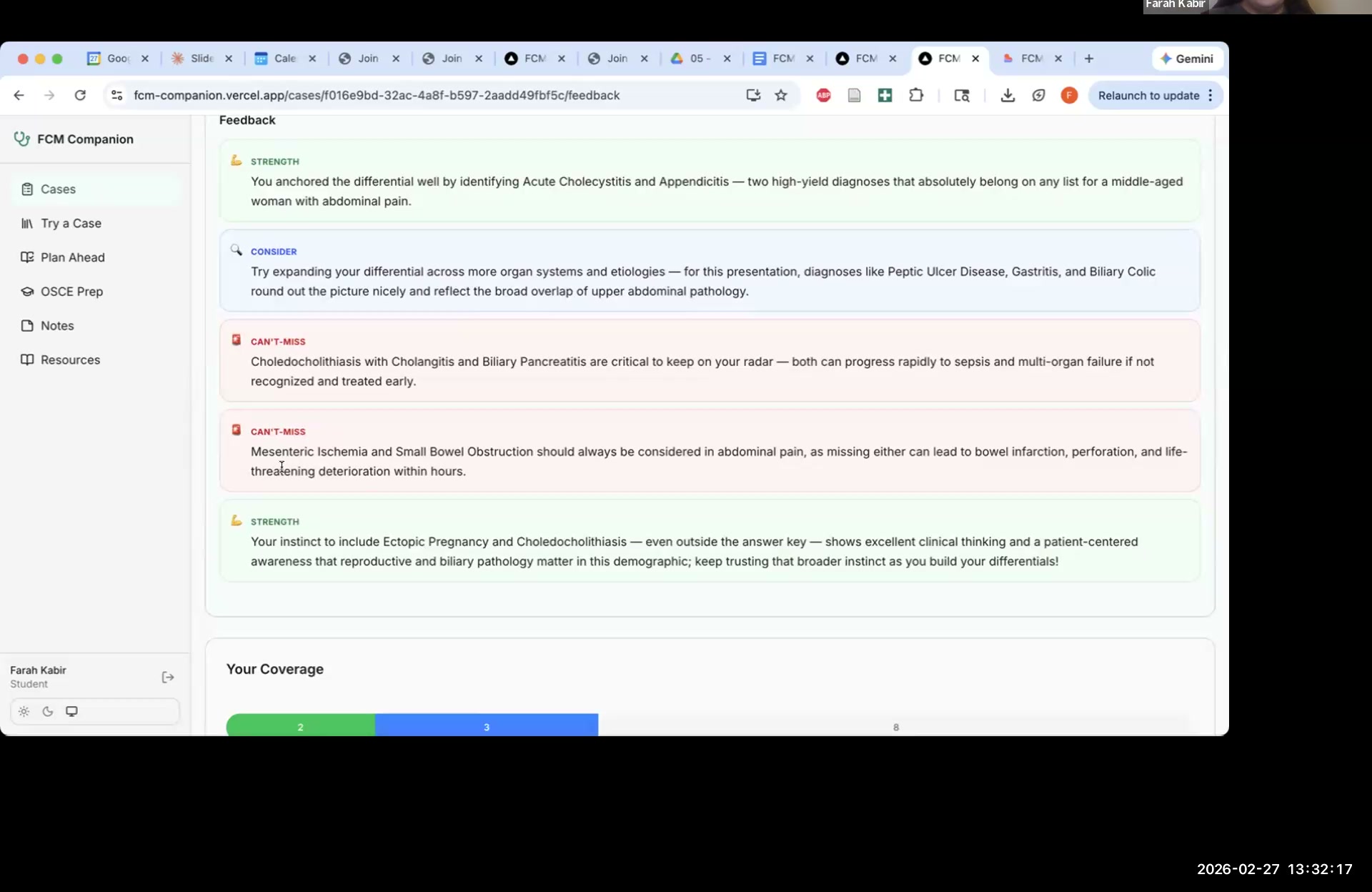
A clinical reasoning platform for medical education. Students submit differential diagnoses with confidence ratings, receive AI-generated feedback highlighting can’t-miss diagnoses, and prepare for sessions with consolidated resources. Faculty see aggregated diagnostic patterns across their cohort.
Design lens: User journey mapping → pain point identification → iterative PRD layering
Journey Mapper & Product Lab
A 4-stage research-to-PRD pipeline: curate user quotes, position your product on an archetype matrix, make trade-off decisions under a 10-point constraint budget, and reinterpret proven patterns from Duolingo, Piazza, and Strava into healthcare contexts. Turns raw user research into structured product requirements.
Design lens: Design facilitation → signal capture → structured synthesis
OSCE Prep Tool
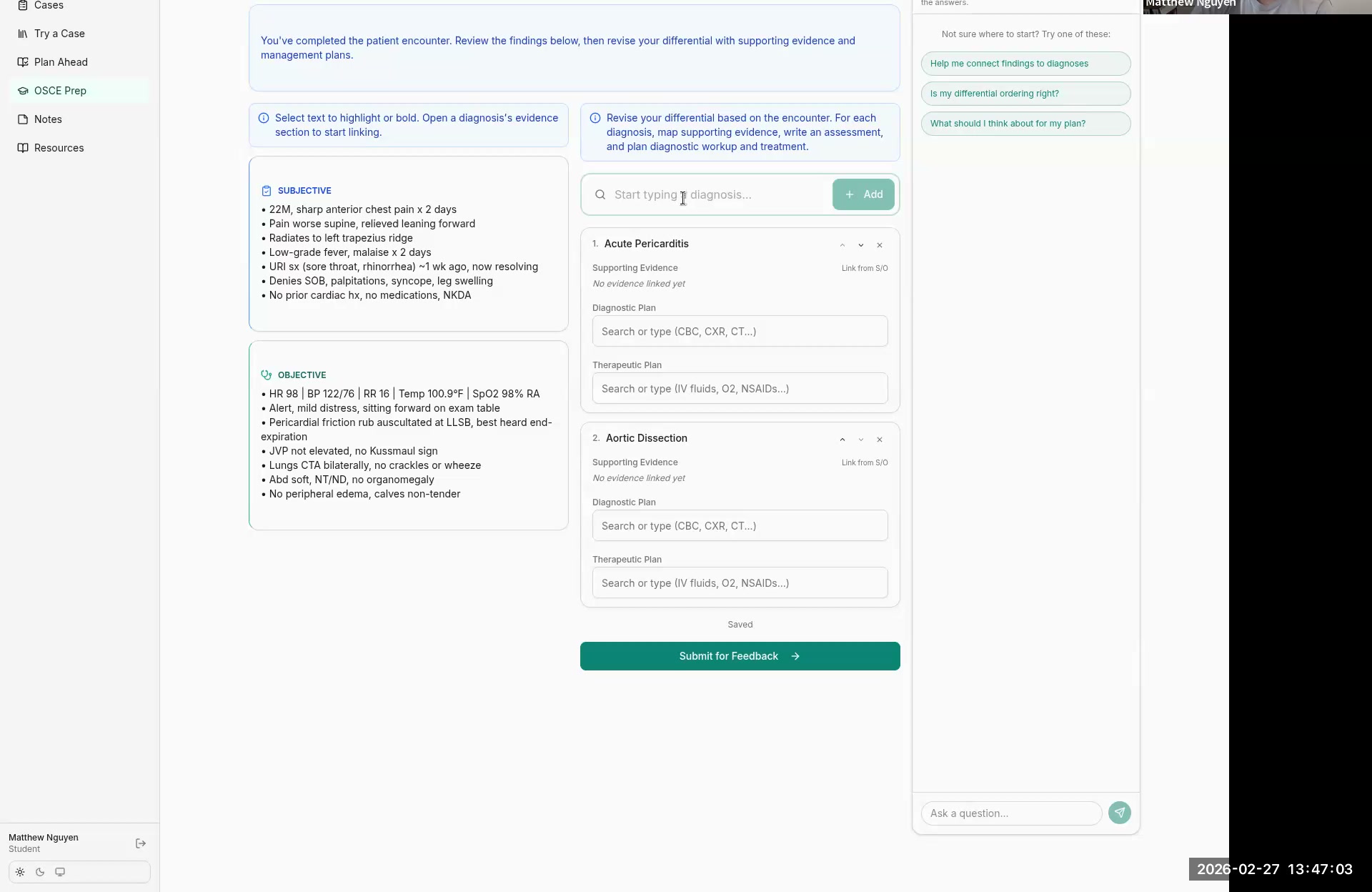
An AI-augmented OSCE preparation tool that transforms static case PDFs into interactive 10-minute simulations. Guides students through differential diagnosis, history-taking, physical exam selection, and SOAP note completion with Socratic AI feedback aligned to clinical competency rubrics.
Design lens: Jobs to be done → anxiety reduction → Socratic pedagogy
Plan Ahead
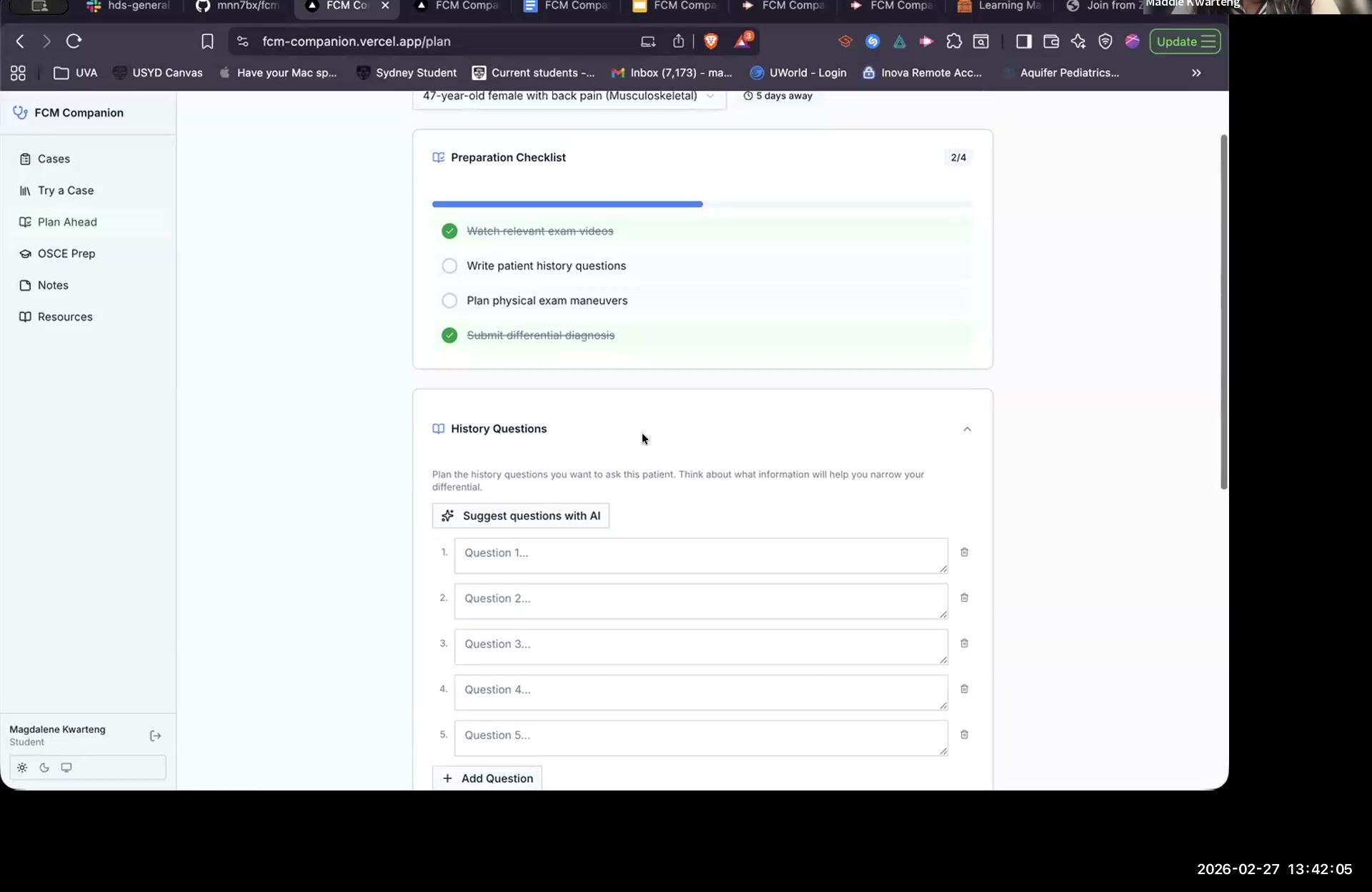
A pre-session preparation dashboard that consolidates fragmented resources — Bates exam videos, physical exam PDFs, instructor reading lists — into a single calm interface with case-specific history questions, PE planning, and session countdown.
Design lens: Cognitive load reduction → resource consolidation → calm design
More Views
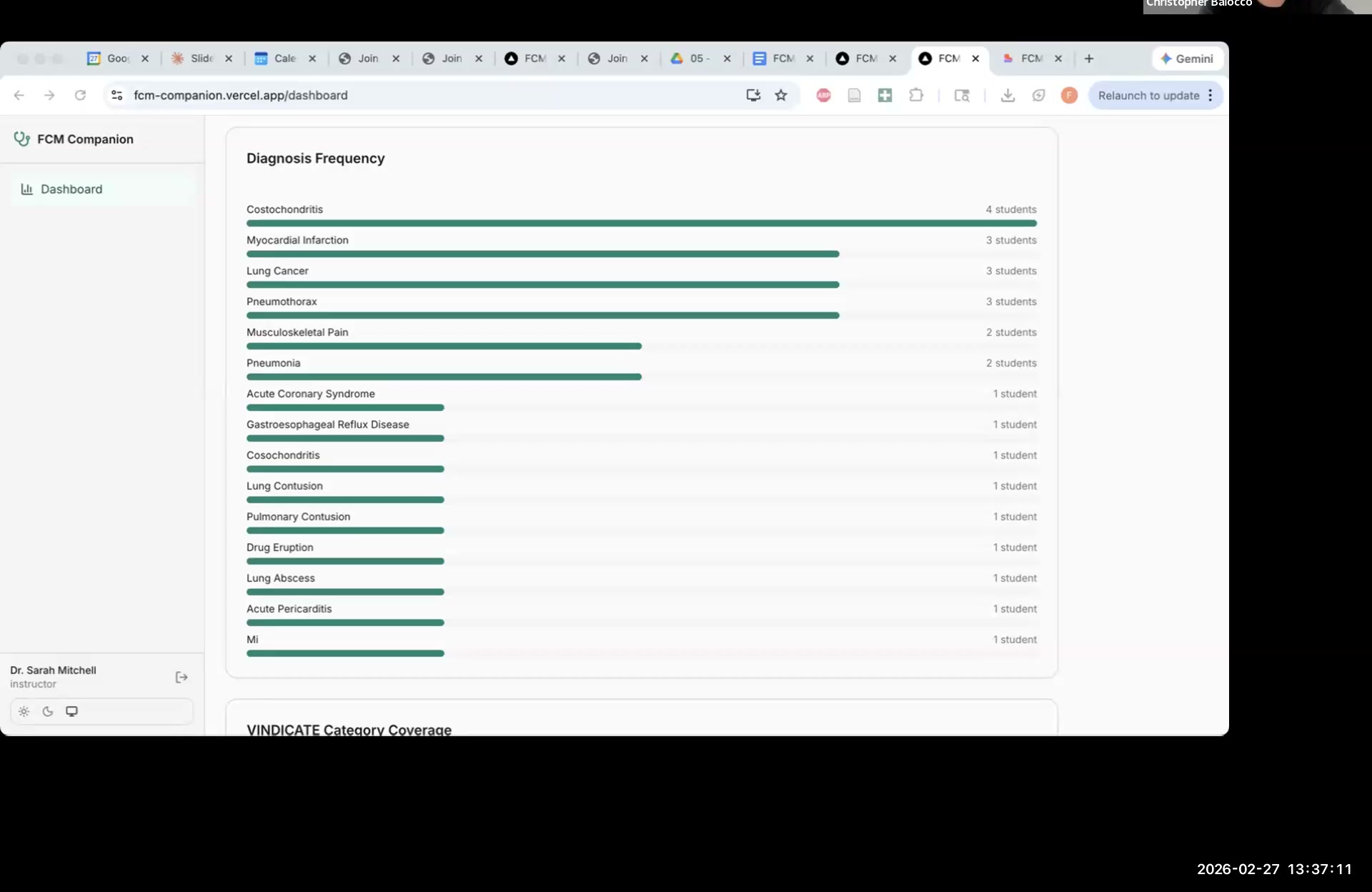
Aggregated diagnostic patterns across the entire cohort — faculty see which diagnoses students are considering and where gaps exist.
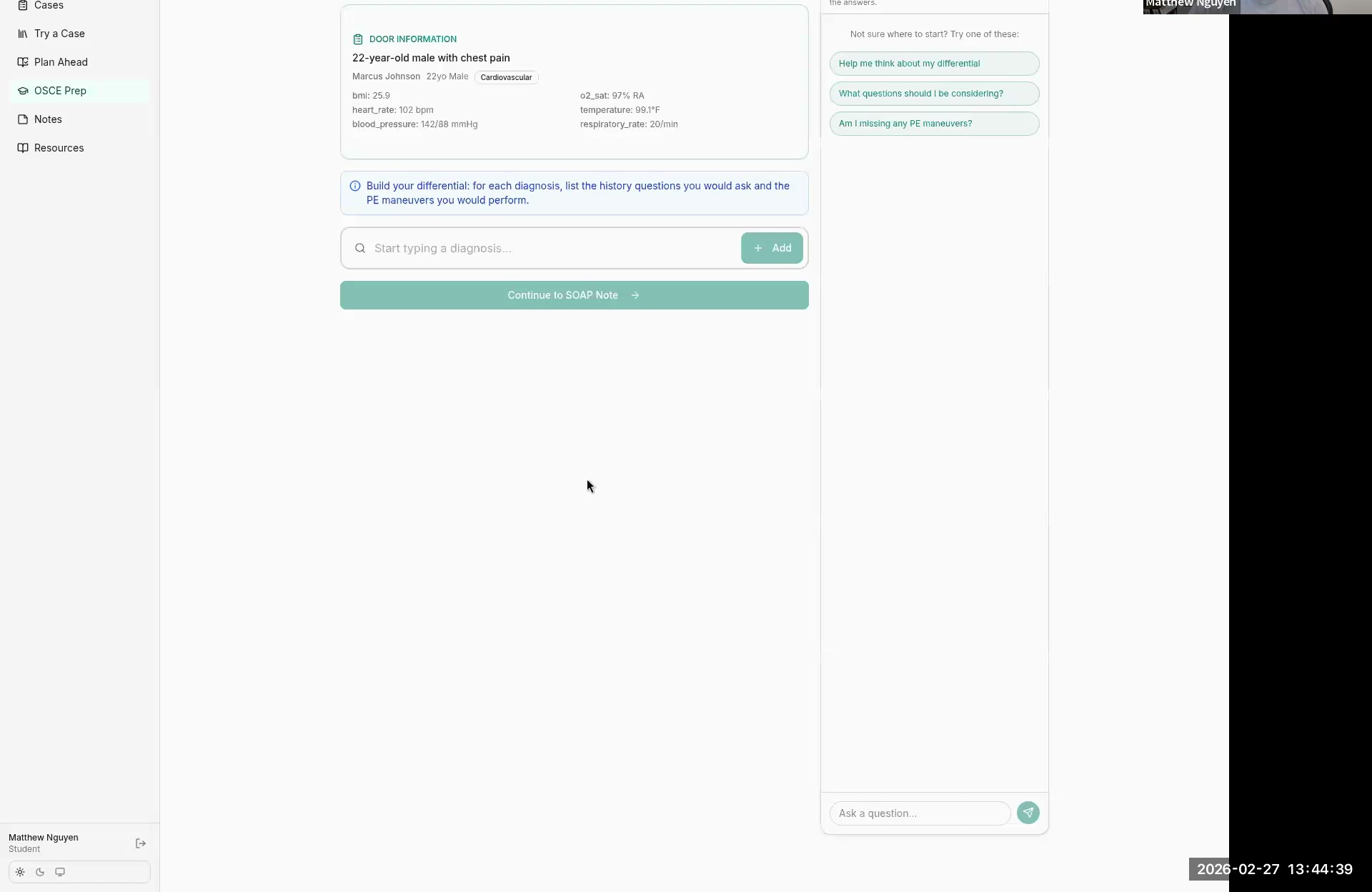
Students select clinical encounters and work through door preparation, building differentials before entering the patient encounter simulation.
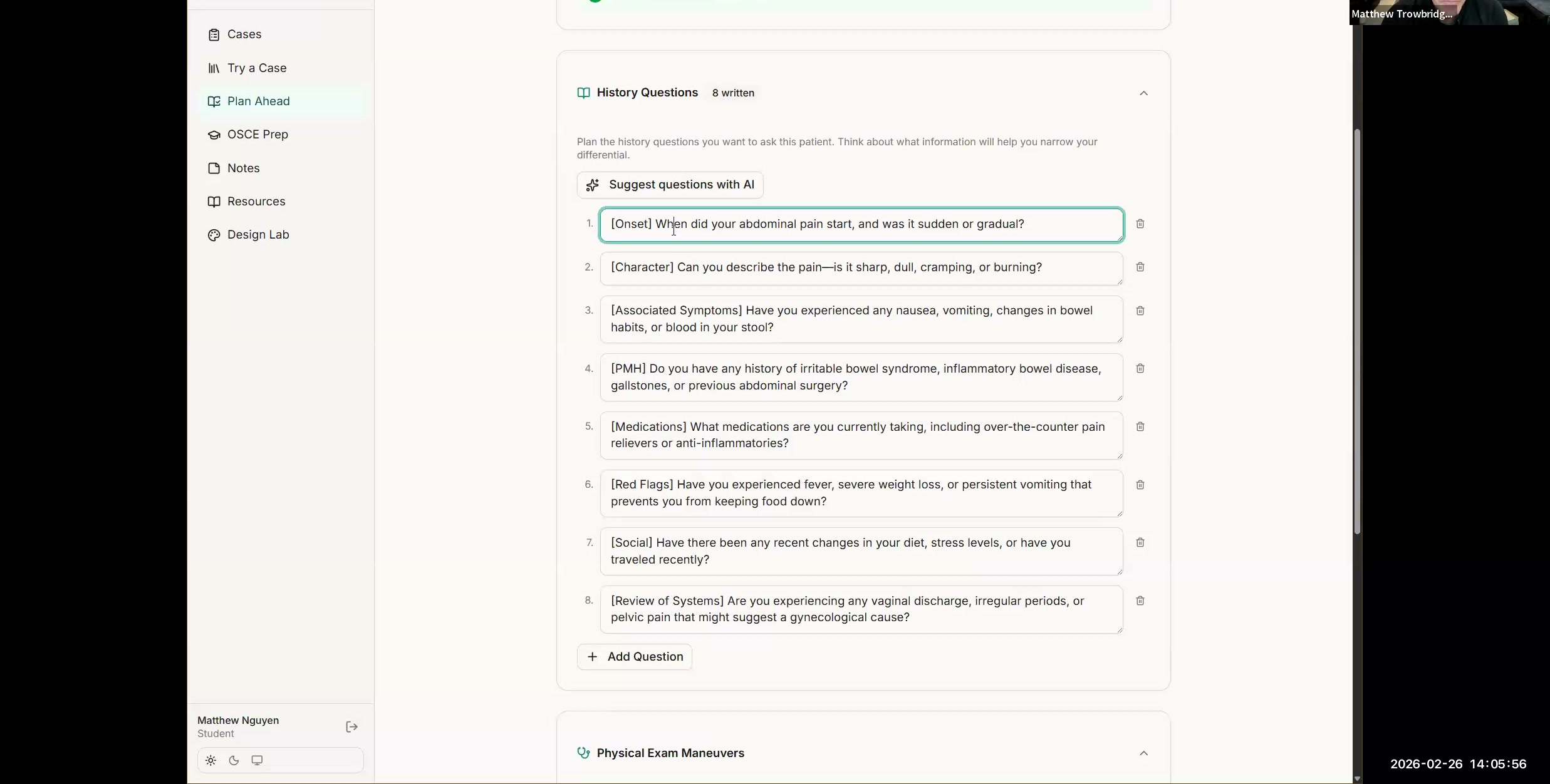
Claude Haiku generates case-specific history questions that help students prepare targeted questioning strategies before their clinical sessions.
In Their Own Words
End-of-course evaluation, February 2026. 6 of 8 students responded. All six granted permission for data use.
(1.5 → 4.2 out of 5)
“I didn’t realize how much agency I had until I began this course. I am now more excited by challenges than discouraged. This introduced a new way of thinking that I’m excited to carry into my practice.”
M4, Radiation Oncology
“This course removed the technical barrier, enabling me to implement ideas I previously would have dismissed.”
M4, Internal Medicine
“Physicians provide more than healthcare services; they have the capacity to reimagine and reshape the systems that deliver it.”
M4, Emergency Medicine
“The moment we went from our first PRD to our V1 of the app was mind blowing. When I realized I could go out and do all the steps on my own — journey mapping to PRD to app — is when it all changed.”
M4, Emergency Medicine
“This course not only taught me how to close the gap between physician knowledge and tech solutions — it showed me that I can do it. This course put me several steps ahead of my colleagues.”
M4, Emergency Medicine
“From the beginning, I’ve always dreamt of developing an innovation that changes healthcare. This course demonstrated that maybe the technical expertise isn’t so important — or at the very least, it makes the attempt feasible.”
M4, Radiation Oncology
One student is continuing to build after the course ended — working on an app for perinatal psychopharmacology in psychiatry. Nobody asked her to.
These tools were built by fourth-year medical students with no prior coding experience, using the Signal-to-Prototype Loop methodology over a 10-day sprint. The Three Tools — domain expertise, design thinking, and generative AI — were all that was needed.